Orienteering:
2024 Calendrier des événements
Results:
Association:
MOA News (2023-10-25)
Training & Education:
Miscellaneous:
Lang: EN FR
Lang: EN FR
Orienteering:
2024 Calendrier des événements
Results:
Association:
MOA News (2023-10-25)
Training & Education:
Miscellaneous:
Lang: EN FR
Lang: EN FR
The basics of orienteering are easy to learn, but the sport offers a lifetime of physical and mental challenges. The sport provides events in which all levels participate together; elite and recreational orienteers, men and women, young children and over 90-year-olds all enjoy the sport together. Orienteering is truly a sport for all ages and abilities.
Using a specially marked detailed map of woods or parkland and a compass,
orienteers navigate between marked checkpoints. Each competitor picks his or her
own route according to individual map-reading skill and physical fitness. An
orange and white control flag at each point allows competitors to confirm they
found the right feature, and in larger events, electronic timing records their
passage similar to a marathon. The challenge is to cover the ground as quickly
as possible and find the checkpoints without hesitation or making navigational
errors.
An orienteering planner designs courses offering different levels of difficulty
by carefully selecting groups of control features which need a similar level of
technical skill to find. For beginners and the very young, the flags are found
on or close to trails, paths, fences and streams. Elite adult competitors
navigate longer complex routes to knolls, depressions, boulders or clearings
deep in the woods. For experienced, older orienteers, the courses are shorter
and avoid very steep or rough terrain while maintaining navigation difficulty.
Orienteering promotes self-confidence and an enjoyment of the outdoors together
with physical fitness, navigation, planning and decision-making skills. Novices
learn how to use a map and compass to efficiently reach places they have never
been before. Elite endurance athletes strive to minimize navigation errors while
covering complex terrain at top speed. The greatest pleasure is in intelligently
meeting the course planner's challenges and completing your course in the
quickest time of the day.
For more details about the sport of orienteering, click here to see its Wikipedia article.
| Title | Content Type | Description | Size |
| Follow me Cervara | Video (.wmv) | This is a video of Thierry Gueorgiou of France, a World Champion Orienteer. This video shows him running through a technically and physically demanding urban Sprint course in Cervara, Italy. Notice the numerous decisions he needs to make while running at a very fast speed. | 5.45 MB |
| Follow me Tero | Video (.wmv) | This is a video of Thierry Gueorgiou of France, a World Champion Orienteer. This video shows the orienteer running 2 legs of a typical Middle/Long distance event. Notice how the runner's route between controls allows him to get there in the shortest possible time. | 7.76 MB |
| Tib'O | Video (.wmv) | This video shows an 11 year-old boy competing in a typical course 1 at an orienteering event. In order for this young boy to succeed he must be able to read a map properly, make hundreds of decisions very quickly, and physically move himself through demanding terrain. | 9.04 MB |
| Jukula (video 1) | Video (.wmv) | These videos show some highlights from the annual Jukula Relay which takes place in Finland every June. The men's relay teams consist of 7 members, and the female 4. The relay begins at 11am, and the first teams cross the finish line between 6 and 7am. In 2005, over 13,000 competitors competed! The mass start is typical in relay events but not in the majority of events which usually use the interval starting system. | 19.7 MB |
| Jukula (video 2) | Video (.wmv) | 7.25 MB | |
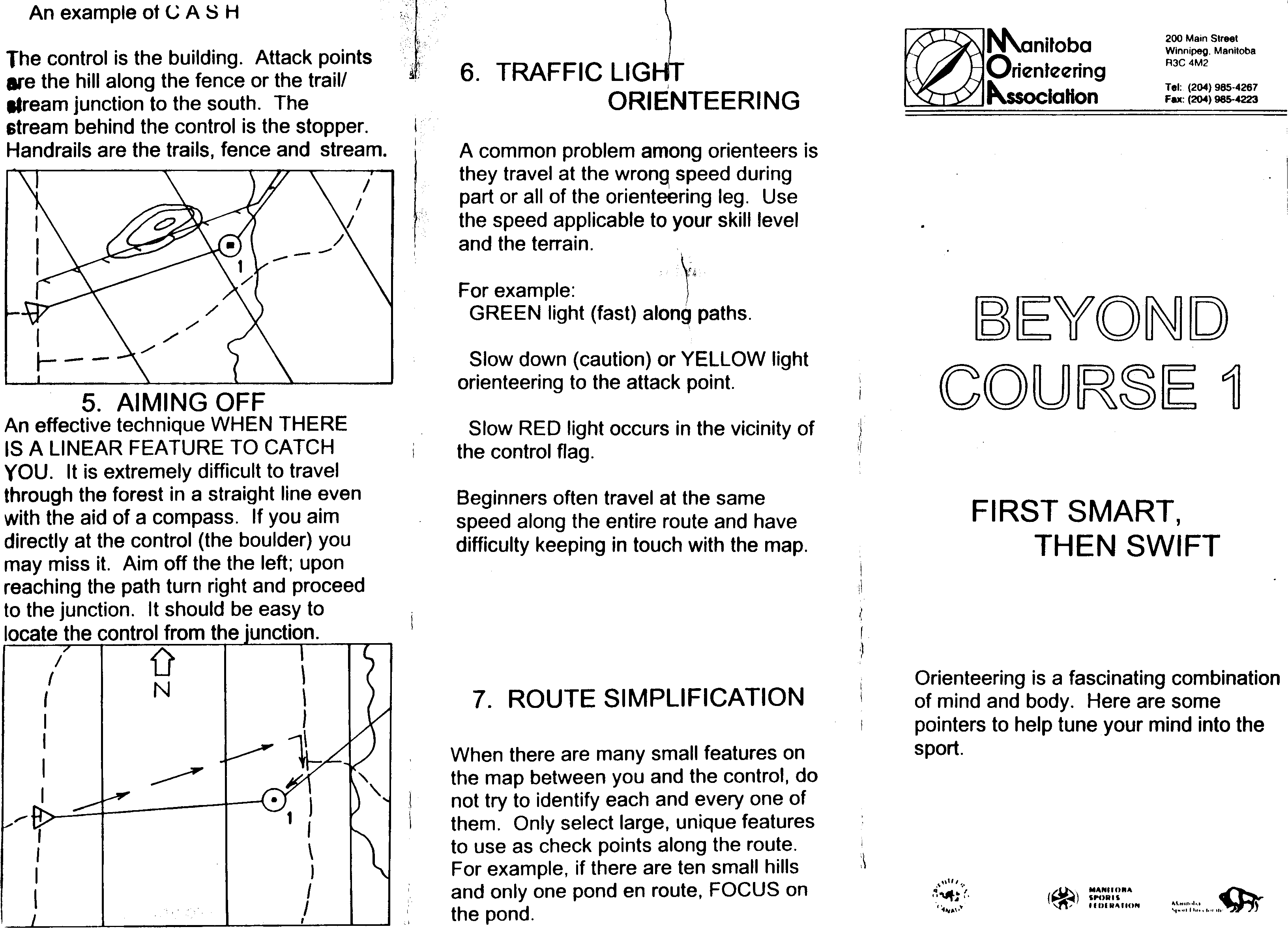
| Beyond Course One Brochure - Page 1 | Image (.gif) | This brochure explains some common orienteering techniques that are helpful for completing advanced courses. | 162 KB |
| Beyond Course One Brochure - Page 2 | Image (.gif) | 191 KB | |
| CBC Radio interview with Don Roe | Audio (.mp3) | The is an audio recording of a radio interview with Don Roe regarding a canoe orienteering event held in 2002. | 458 KB |
| Meet Safety, Rules & Ethics | Document (.doc) | This Word document lists general rules/guidelines for orienteering competitions. | 30 KB |
Les bases de la course d'orientation sont faciles à apprendre, mais ce sport offre une vie entière de défis physiques et mentaux. Les événements organisés dans le cadre de ce sport rassemblent des participants de tous niveaux : du compétiteur de haut niveau au pratiquant occasionnel, hommes et femmes, jeunes enfants et personnes âgées de plus de 90 ans, tous apprécient ce sport ensemble. La course d'orientation est vraiment un sport pour tous les âges et toutes les aptitudes.
En utilisant une carte spécifique détaillée des bois ou du parc et une boussole,
les orienteurs choisissent leurs routes entre des postes de contrôle indiqués.
Chaque compétiteur choisit son propre itinéraire en fonction de son aptitude à
lire les cartes et de sa forme physique. Une balise orange et blanche placée à
chaque poste permet aux compétiteurs de confirmer qu'ils ont trouvé le bon
endroit, et lors d'événements plus importants, un système de chronométrage
électronique enregistre leur passage comme lors d'un marathon. Le défi est de
finir son parcours le plus rapidement possible et de trouver tous les points de
contrôle sans hésitation et sans faire d'erreur de navigation.
Un organisateur de course d'orientation crée des parcours offrant différents
niveaux de difficulté en sélectionnant attentivement des balises situées sur des
éléments particuliers de terrain, nécessitant pour les trouver un niveau
technique similaire. Pour les débutants et les très jeunes participants, les
balises sont placées sur ou proche des chemins, sentiers, clôtures et cours
d'eau. Les compétiteurs adultes de catégorie « élite » doivent courir sur des
itinéraires complexes vers des buttes, des dépressions, des rochers ou des
clairières au beau milieu des bois. Pour les orienteurs expérimentés et plus
âgés, les parcours sont plus courts et évitent les terrains trop pentus ou
accidentés tout en conservant la difficulté de navigation.
La course d'orientation encourage le développement de la confiance en soi et le
plaisir des activités extérieures ainsi que l'amélioration de la condition
physique, des capacités de navigation, de la planification et des prises de
décisions. Les débutants apprennent à utiliser une carte et une boussole pour
atteindre de manière efficace des lieux où ils ne sont jamais allés auparavant.
Les athlètes d'endurance de haut niveau s'efforcent de minimiser les erreurs de
navigation tout en couvrant un terrain complexe le plus rapidement possible. Le
plus grand plaisir de cette activité est de répondre intelligemment à tous les
défis proposés par l'organisateur de la course et de finir votre parcours dans
le temps le plus court de la journée.
Pour plus de détails sur la course d'orientation, cliquez ici pour voir l'article wikipedia.
| Titre | Type de contenu | Description | Taille |
| Follow me Cervara | Video (.wmv) | Une vidéo du français Thierry Gueorgiou, Champion du Monde de course d'orientation. Cette vidéo le montre courant un sprint urbain très technique et physique à Cervara en Italie. Remarquez les nombreuses décisions qu'il doit prendre tout en courant très rapidement. | 5.45 Mo |
| Follow me Tero | Video (.wmv) | Une vidéo du français Thierry Gueorgiou, Champion du Monde de course d'orientation. Cette vidéo montre l'orienteur courant deux étapes d'un parcours typique d'un événement moyenne/longue distance. Remarquez comment l'itinéraire choisi par l'orienteur entre les contrôles lui permet d'y arriver le plus rapidement possible. | 7.76 Mo |
| Tib'O | Video (.wmv) | Cette vidéo montre un garçon de 11 ans participant à une course d'orientation de niveau 1 lors d'un événement. Pour que ce jeune garçon réussisse, il doit être capable de lire une carte correctement, de prendre des centaines de décisions rapidement, et de se déplacer lui-même à travers un terrain complexe. | 9.04 Mo |
| Jukola (video 1) | Video (.wmv) | Ces vidéos montrent des extraits du Relai Jukola annuel qui a lieu en Finlande tous les ans en juin. Les équipes de relai masculines comptent 7 membres et les féminines 4. Le relai commence à 11h et les premières équipes franchissent la ligne d'arrivée entre 18 et 19h. En 2005, plus de 13000 compétiteurs ont participé ! Le départ groupé est classique lors des relais mais pour la grande majorité des événements le départ est échelonné. | 19.7 Mo |
| Jukola (video 2) | Video (.wmv) | 7.25 Mo | |
| Beyond Course One Brochure - Page 1 | Image (.gif) | Cette brochure (en anglais) explique quelques techniques classiques d'orientation qui sont utiles pour finir les courses de niveau avancé. | 162 Ko |
| Beyond Course One Brochure - Page 2 | Image (.gif) | 191 Ko | |
| CBC Radio interview with Don Roe | Audio (.mp3) | Enregistrement audio d'une interview de Don Roe concernant un événement de course d'orientation en canoë qui a eu lieu en 2002. (en anglais) | 458 Ko |
| Meet Safety, Rules & Ethics | Document (.doc) | Ce document Word liste les règles générales et recommandations pour les compétitions de courses d'orientation. (en anglais) | 30 Ko |